Rolling mills are an essential part of the metal manufacturing industry, where machinery operates under high loads, temperatures, and continuous production conditions. The performance and reliability of rolling mill equipment depend heavily on the quality of its critical components. Among these, forged rings play an important role in applications that require strength, durability, dimensional accuracy, and resistance to wear.
For rolling mill operators, choosing the right forged rings manufacturer is therefore an important business decision. A reliable manufacturer can provide components designed to withstand demanding operating conditions while helping improve equipment performance and reduce maintenance requirements.
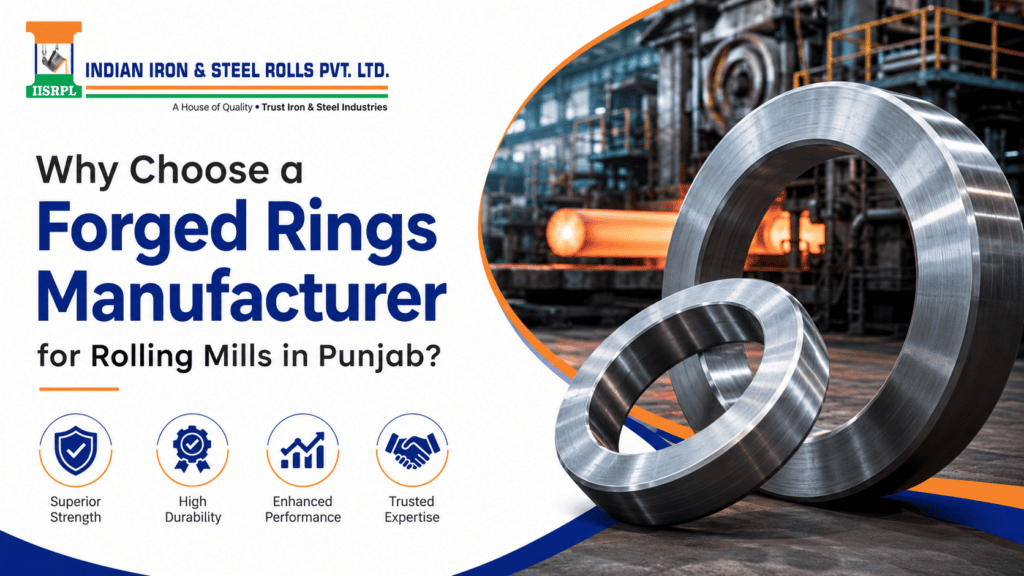
Punjab has developed into an important manufacturing and engineering hub, with manufacturers offering forged components for a wide range of industrial applications. But why should rolling mill companies choose a specialized forged rings manufacturer in Punjab?
What Are Forged Rings?
Forged rings are circular metal components manufactured through a forging process in which metal is shaped under controlled pressure. Unlike simple cast components, forged products can offer improved mechanical properties because the forging process helps develop a strong and consistent grain structure.
Depending on the application, forged rings can be manufactured from different grades of alloy steel, carbon steel, stainless steel, and other engineering materials.
In rolling mills, forged rings may be used in demanding mechanical assemblies and equipment where components are exposed to substantial loads, repeated stresses, friction, and operating temperatures.
Importance of Forged Rings in Rolling Mills
Rolling mill machinery must operate reliably for long production cycles. A failure of a critical component can result in unplanned downtime, production losses, and increased maintenance costs.
High-quality forged rings can contribute to:
- Better load-bearing capacity
- Improved resistance to mechanical stress
- Higher wear resistance
- Greater dimensional stability
- Longer component service life
- Reduced risk of premature failure
- Reliable performance in demanding applications
The exact properties required depend on the rolling mill design, operating conditions, material being processed, and application of the forged ring.
Why Choose a Forged Rings Manufacturer in Punjab?
1. Access to a Strong Industrial Manufacturing Base
Punjab has a well-established industrial ecosystem covering engineering, steel, fabrication, machining, and metalworking industries. This provides manufacturers with access to technical expertise, skilled workers, raw materials, machining capabilities, and supporting industrial services.
For rolling mill companies, working with a Punjab-based manufacturer can make sourcing industrial forged components more convenient and efficient.
2. Customized Forged Rings for Different Applications
Every rolling mill does not use identical machinery or components. Forged rings may need to meet specific requirements related to dimensions, material grade, hardness, tolerances, and mechanical properties.
A capable manufacturer can produce forged rings according to customer drawings, specifications, or application requirements.
Customization may include:
- Outer and inner diameter
- Ring thickness
- Material grade
- Heat-treatment requirements
- Machining tolerances
- Surface finish
- Hardness requirements
- Inspection and testing requirements
This flexibility allows manufacturers to supply components that fit the intended equipment instead of relying only on standard sizes.
3. High Strength and Durability
Forging is widely used for components that need to withstand demanding mechanical conditions. Properly manufactured forged rings can provide the strength and toughness required for heavy-duty industrial applications.
For rolling mills, where components may experience continuous loads and repeated mechanical stresses, selecting appropriately engineered forged rings can help support dependable equipment operation.
4. Better Dimensional Accuracy
Rolling mill components often require accurate dimensions and proper fitment. Even small dimensional variations can affect assembly, alignment, and equipment performance.
A professional forged rings manufacturer can combine forging with precision machining and inspection processes to achieve the required dimensions and tolerances.
This can make installation easier and help ensure compatibility with the corresponding machinery.
5. Controlled Heat Treatment
Heat treatment is an important part of manufacturing many forged steel components. Processes such as normalizing, annealing, quenching, and tempering may be used depending on the material and required properties.
A manufacturer with suitable heat-treatment capabilities can control properties such as hardness, strength, and toughness according to the specified application.
For rolling mill components, appropriate heat treatment can be particularly important because of the demanding mechanical environment in which the components operate.
6. Quality Inspection and Testing
Quality assurance is essential when manufacturing components for heavy industrial equipment.
A reliable manufacturer should have appropriate inspection and testing procedures throughout the production process. Depending on the customer’s requirements, forged rings may undergo dimensional inspection, hardness testing, chemical analysis, and non-destructive testing.
Common inspection methods can include:
- Dimensional inspection
- Ultrasonic testing
- Magnetic particle testing
- Hardness testing
- Chemical composition analysis
- Mechanical testing
- Visual inspection
Proper quality control helps identify manufacturing defects and ensures that the finished component meets the required specifications.
Key Factors to Consider When Selecting a Forged Rings Manufacturer
Choosing a supplier based only on price can create problems in the long run. Rolling mill companies should evaluate several factors before placing an order.
Manufacturing Capability
Check whether the manufacturer has suitable forging equipment, machining facilities, heat-treatment capabilities, and inspection systems for the required ring size and material.
Material Expertise
The manufacturer should understand the material requirements of heavy-duty industrial applications and be capable of sourcing and processing the specified steel grade.
Customization
If your rolling mill requires non-standard dimensions or special mechanical properties, select a manufacturer capable of producing customized forged rings.
Quality Standards
Ask about quality-control procedures, inspection equipment, testing facilities, and documentation provided with the finished product.
Experience
Industry experience can be valuable when dealing with complex forged components. An experienced manufacturer is more likely to understand common manufacturing challenges and application requirements.
Delivery Capability
Timely delivery is important for rolling mills because delays in receiving replacement components can affect maintenance schedules and production planning.
Technical Support
A manufacturer that can communicate effectively about material selection, dimensions, heat treatment, machining, and inspection can make the procurement process smoother.
Applications of Forged Rings in Rolling Mill Equipment
Forged rings can be manufactured for various heavy engineering and rolling mill applications. Depending on the design and specifications, they may be incorporated into assemblies associated with:
- Rolling mill machinery
- Steel processing equipment
- Heavy-duty mechanical assemblies
- Gear and drive systems
- Industrial shafts and rotating assemblies
- Supporting mechanical components
- High-load equipment
The specific application determines the required material, dimensions, heat treatment, hardness, and machining specifications.
Forged Rings vs. Cast Rings
Both forging and casting are established metal manufacturing processes, but they have different characteristics.
Forged rings are produced by mechanically deforming heated metal under controlled conditions. This can provide favorable grain flow and mechanical properties for applications involving high loads and repeated stresses.
Cast rings, on the other hand, are produced by pouring molten metal into a mold and allowing it to solidify.
For demanding applications, forged components are often selected when strength, toughness, and fatigue resistance are important considerations. However, the appropriate manufacturing method should always be determined according to the component’s design and operating requirements.
How a Professional Manufacturer Ensures Quality
A dependable forged rings manufacturer generally follows a controlled production process.
Step 1: Material Selection
The appropriate raw material is selected according to the customer’s specifications and intended application.
Step 2: Heating
The material is heated to the required forging temperature under controlled conditions.
Step 3: Forging
The heated material is shaped using suitable forging equipment to achieve the required ring geometry and material properties.
Step 4: Heat Treatment
The forged component undergoes the specified heat-treatment process to achieve the required mechanical characteristics.
Step 5: Machining
Where required, machining is performed to achieve accurate dimensions, tolerances, holes, grooves, surfaces, or other specified features.
Step 6: Inspection
The finished forged ring is inspected and tested according to the customer’s quality requirements.
Step 7: Finishing and Dispatch
After final inspection and documentation, the component is prepared for safe transportation and delivery.
Benefits for Rolling Mill Operators
Working with a reliable forged rings manufacturer can provide several operational benefits.
- Reduced Maintenance Problems
High-quality components manufactured according to appropriate specifications can help reduce premature component failures and unnecessary maintenance interventions.
- Improved Equipment Reliability
Strong and properly machined components can contribute to reliable operation of rolling mill equipment.
- Longer Service Life
The right combination of material, forging process, heat treatment, and machining can improve the durability of components in demanding environments.
- Better Production Planning
A dependable supplier with consistent manufacturing and delivery capabilities can make it easier to plan maintenance and component replacement.
- Cost Efficiency
Although initial component price is important, total cost of ownership should also be considered. A component that provides better durability and reliability may offer greater long-term value than a cheaper alternative.
Why Quality Matters More Than Price
For rolling mill operations, the cheapest component is not necessarily the most economical option.
A low-cost forged ring that fails prematurely can lead to:
- Equipment downtime
- Production interruptions
- Emergency replacement costs
- Additional labor expenses
- Maintenance delays
- Potential damage to connected components
For this reason, buyers should consider quality, reliability, service life, manufacturing capability, and technical support along with purchase price.
Questions to Ask Before Ordering Forged Rings
Before selecting a manufacturer, rolling mill companies can ask:
- Can you manufacture forged rings according to our drawings?
- Which material grades can you supply?
- What ring sizes and weights can you manufacture?
- What heat-treatment processes are available?
- What machining tolerances can you achieve?
- Which inspection and testing methods are available?
- Can you provide material and inspection certificates?
- What is your production lead time?
- Do you have experience supplying components for rolling mills?
- Can you provide technical assistance during specification and manufacturing?
Getting clear answers to these questions can help buyers identify a manufacturer that matches their technical and production requirements.
Conclusion
Choosing the right forged rings manufacturer for rolling mills in Punjab can have a direct impact on component reliability, maintenance planning, and overall equipment performance. A manufacturer with strong forging capabilities, quality-control systems, heat-treatment facilities, precision machining, and technical expertise can provide components designed for demanding industrial applications.
Rather than focusing solely on price, rolling mill operators should evaluate material quality, manufacturing capabilities, dimensional accuracy, testing procedures, customization options, delivery reliability, and technical support.
With the right manufacturing partner, forged rings can become a dependable part of a rolling mill’s maintenance and equipment strategy, helping support efficient and reliable industrial operations.
Looking for a Reliable Forged Rings Manufacturer in Punjab?
If you are looking for custom forged rings for rolling mills, choose a manufacturer that understands the requirements of heavy-duty industrial applications and can manufacture components according to your specifications.
Share your required dimensions, material grade, quantity, drawings, and technical requirements with a qualified manufacturer to discuss the right forged ring solution for your rolling mill.